With support from GM Business Growth Hub, Vector Labs is turning sustainable materials innovation into market-ready housing technologies.

new jobs forecast by 2026/27

innovation grant funding across three different projects

investment from Greater Manchester ecosystem
Manchester-based Vector Labs is developing sustainable materials and technologies that improve energy performance and reduce environmental impact in housebuilding.
From a venture that started a few years ago as something fitted around day jobs, the clean-tech company’s journey shows what can happen when ambitious ideas are matched with the right partners, facilities and innovation support.
Accelerating low-carbon housing innovation
Formed in 2020 to address the construction sector's inefficiencies and environmental shortcomings, Vector Labs identified three key problems: a global undersupply of housing, outdated and overpriced housing models, and the use of unsustainable materials and systems.
“Not only does it typically take six to nine months to build and fit a standard brick house, but housing is over three times more expensive than it was 25 years ago,” says Liam Britnell, Chief Technology Officer. “Then there’s the fact that the construction sector accounts for a third of the country’s greenhouse gas emissions.”
The company set out to create a new housing system, where homes are manufactured in sections off-site and assembled quickly on location. The first materials product development project was in using waste and post-consumer recycled materials – used packaging, for example – enhanced with nanomaterials such as graphene, to raise performance while reducing environmental impact.

Verification and prototyping
To achieve market acceptance, Vector needed third-party verification of the performance of its materials, as a first step towards regulatory approval for sales into the polymer additives sector. Our position at the centre of the region’s innovation community meant we could quickly connect Vector with the right people and institutions to help overcome technical challenges and accelerate its journey to market.
“We knew we would benefit by bringing in expertise from outside,” recalls Liam. “There are lots of places you can find very generic business support, but if it's with the wrong people it can definitely end up being a bit of a time-waster.
“Fortunately, I'd heard positive feedback from other companies about the value that GM Business Growth Hub can add, so when we approached them, we were confident that we’d get something useful out of it. They carried out an audit on the business to identify where they could add the most value, and one of the areas was around accessing testing for the panelling we were developing. The Innovation team highlighted the need for a collaboration project to validate the new material.”
We introduced Vector to the University of Salford’s Thermal Measurement Laboratory and Acoustic Testing Laboratory, which had the required expertise and facilities. We also scoped out the project's timeline, budget and deliverables, and provided £5,000 in innovation grant funding to cover half the cost of the project. The work contributed to what Liam describes as ‘more empirical data than most occupied houses in the world,” giving robust performance benchmarks for thermal and acoustic characteristics.
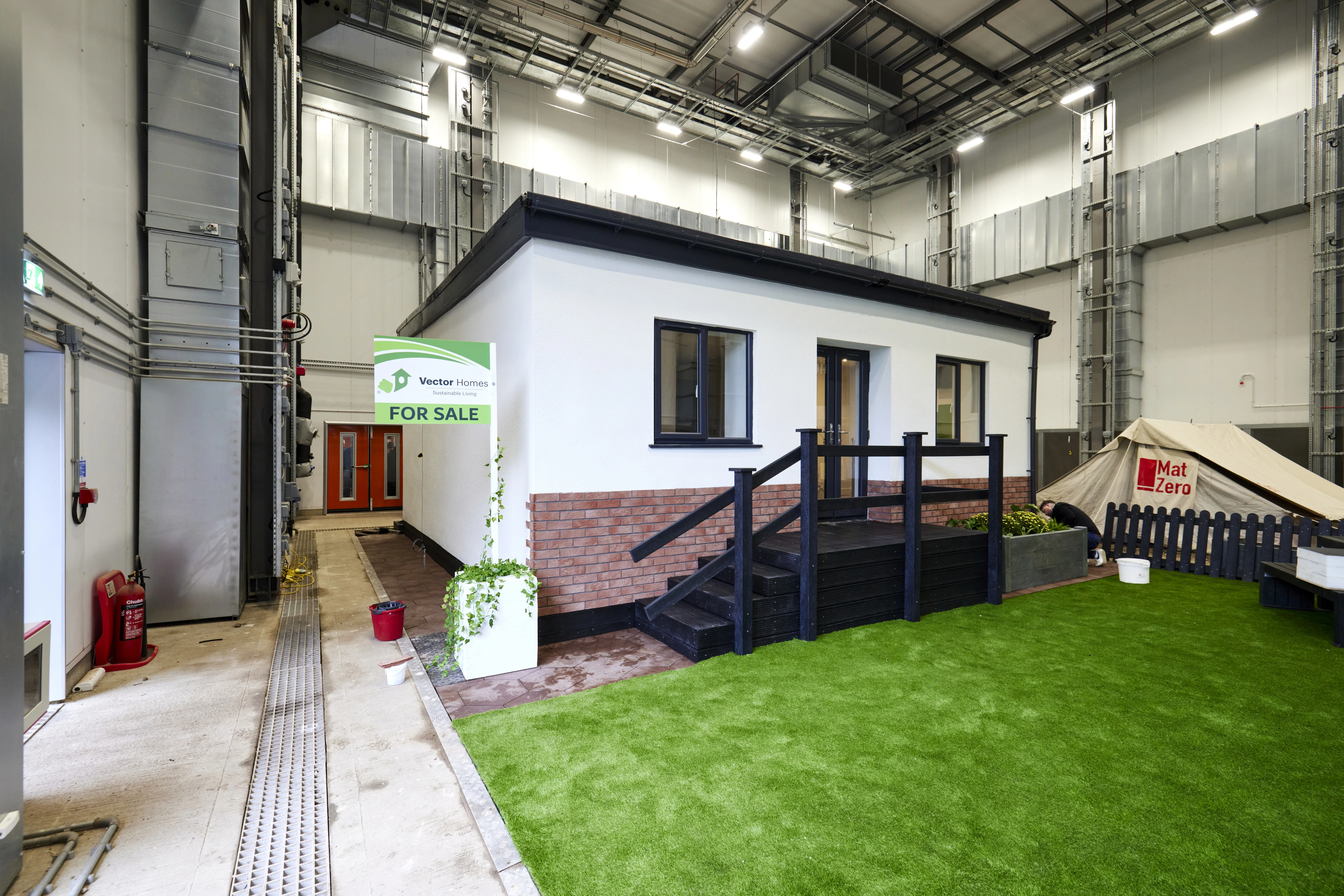
That evidence base helped unlock the next milestone: the launch of Vector’s first prototype eco-home at the University’s Energy House 2.0 facility. Backed by £39,000 of support from the Future Homes programme, the house drew attention from major housebuilders and investors, "an absolute game-changer for us", says COO Jonas.

Rapid sample production and testing
The next stage was for Vector to create multiple small test batches of their graphene-enhanced foam, enabling Liam and his team to explore more variations and identify the best-performing options. The company secured £15,000 in innovation grant funding to cover 100% of the costs of collaborating with the University of Manchester’s Graphene Engineering Innovation Centre (GEIC) to move the product closer to market.
Our Innovation team again helped steer the admin and funding application, and acted as that vital link between the business and academia.
Validating a new product line
Vector also identified a separate commercial opportunity: a low-cost heat flux sensor, which measures how quickly heat moves through a wall, helping assess real-world heat loss and support decarbonisation of housing.
The resulting prototype used graphene in its sensing element, allowing it to be manufactured using more widely available, and potentially renewable, materials. To move from prototype to product, though, Vector needed independent testing in a relevant environment.
With £19,995 in innovation grant funding, Vector reviewed and validated the sensor within Energy House 2.0’s climate chambers, across multiple home types and operating conditions. The project generated standardised performance evidence that could be shared with architects, engineers, regulators and customers.
A ‘phenomenal’ ecosystem of business innovation support
The company is now scaling up, with one new full-time job already created and four more expected in 2026/27, and is forecasting significant growth in the same financial year. Vector is forecasting significant efficiency gains over the next three years, with productivity per hour projected to rise by 4,500% and output per worker by 1,200% from its current baseline.
In total, the business has leveraged more than £600,000 in funding and investment from Greater Manchester, while introductions across the region’s ecosystem have also helped Vector build its supply-chain and delivery capability, including partnerships with F&T Terrix and Saint Gobain.
“We've developed some really great collaborative commercial partnerships with companies that we've met through people at GM Business Growth Hub,” says Liam. “The Growth Hub has been important in helping us move along our technology roadmap. From early business support to accessing Greater Manchester’s rich innovation ecosystem, their guidance has been instrumental. Without the external support we’ve received, we wouldn’t be here today.”
This rapid journey shows how collaboration can help overcome barriers and achieve market impact. As Nathan, CEO, adds: “There is a phenomenal innovation ecosystem in Greater Manchester that really enables rapid iteration and development cycles.”
We’re here to help
“The team at Vector Homes are technical experts with bold ideas,” says Russell Mansfield, Commercialisation Specialist at GM Business Growth Hub, “but they required guidance on connecting with the right partners and navigating the funding landscape to bring their vision to life. We’re always just a phone call away. Innovation isn’t just about solving a single problem – it’s an ongoing journey, and we’re here to help at every stage.”
Call us on 0161 359 3050 or email bgh@growthco.uk to find out how GM Business Growth Hub can support your next stage of growth.
Get in touch
Please contact us at 0161 3593050 or query below.
Take that first step and we’ll support you with whatever you need to succeed.
Sign-up to our newsletter
Insights, news, events and opportunities straight to your inbox.