By Matt Richardson, Head of Social Impact and Procurement Estimated reading time: 2–3 minutes Date: 11th November 2026
A successful business depends on its people. Their skills, experience and commitment all contribute to the quality of your products and services, your relationships with customers and, ultimately, your ability to grow.
Pay is an important part of recognising that contribution. While businesses face real financial pressures, offering fair pay can help create a more motivated, stable and productive workforce.
One way employers can demonstrate their commitment to fair pay is by becoming a Real Living Wage Employer. But what does this mean, what are the potential benefits, and how can your business work towards it?
What is the Real Living Wage?
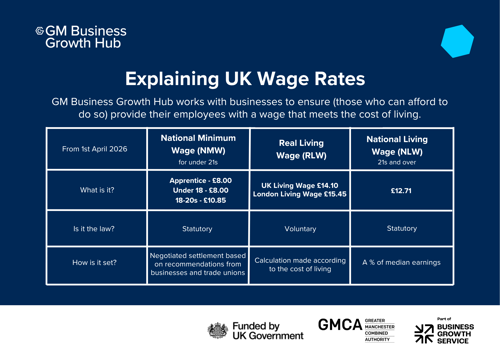
The Real Living Wage is a voluntary hourly rate independently calculated to reflect the cost of living. It is based on what people need to earn to meet everyday living costs, rather than being set by the Government.
It is different from the National Living Wage, which is the statutory minimum hourly rate employers must pay eligible workers aged 21 and over. The National Minimum Wage applies to younger workers and apprentices.
For 2026/27, the Real Living Wage is:
-
£14.10 an hour across the UK.
-
£15.45 an hour in London.
By comparison, the current statutory National Living Wage for workers aged 21 and over is £12.71 an hour. This means the Real Living Wage is £1.39 higher per hour outside London.
The rates are reviewed annually by the Living Wage Foundation. Employers accredited with the Foundation have until 1 May 2027 to implement the new 2026/27 rates.
The Real Living Wage is not a legal requirement, but it provides employers with a recognised way to demonstrate their commitment to paying workers a wage that better reflects the cost of living.
Why is paying the Real Living Wage important?
Paying a fair wage is first and foremost about supporting the people who work for you. However, it can also bring wider benefits to your organisation.
Attracting and retaining talent
Recruiting and retaining good employees is a challenge for many businesses. Offering fair pay can help make your organisation a more attractive place to work and give existing employees a stronger reason to stay.
Research from the Living Wage Foundation found that 68% of employers said paying the Real Living Wage had improved their recruitment outcomes. A more stable workforce can also help businesses retain valuable experience, reduce recruitment costs and maintain continuity.
Building a motivated workforce
Employees who feel valued and fairly rewarded are more likely to feel positive about their work. While pay alone does not determine job satisfaction or productivity, it is an important part of creating an environment where people feel recognised and supported.
Fair pay should sit alongside other good employment practices, including opportunities for development, effective management, flexible working where possible and a healthy workplace culture.
Strengthening your reputation and social impact
Customers, employees, suppliers and business partners increasingly consider how organisations treat their people.
Paying the Real Living Wage can help demonstrate that your business takes responsible employment seriously. It can also support wider social value commitments, particularly when working with public sector organisations or bidding for contracts where social value is considered.
The Living Wage Foundation reports that more than a third of employers surveyed said paying the Real Living Wage had helped them secure contracts and funding.

Financial challenges?
We acknowledge the cost-of-living crisis and other challenges businesses currently face, so if cost is a concern, many businesses demonstrate value for staff in other ways such as reward and recognition, professional development opportunities, fostering teamwork through team-building activities, empowering employees in decision-making, flexible work opportunities and promoting work life balance.
How can your business get started?
If you are considering becoming a Real Living Wage Employer, the Living Wage Foundation provides guidance on the rates, accreditation process and what is involved in making the commitment.
A good starting point is to review the pay rates across your organisation and identify any gaps between current salaries and the Real Living Wage. You should also consider the people who work for your business through regular subcontracting arrangements, as these are included in the Foundation's accreditation requirements.
Accreditation gives your organisation formal recognition as a Living Wage Employer, including the right to display the Living Wage Employer Mark. It also demonstrates your commitment to fair pay to employees, prospective recruits, customers and business partners.
You can find out more about the rates and accreditation process on the Living Wage Foundation website.
Supporting good employment in Greater Manchester
Fair pay is an important part of building a responsible and sustainable business. It can help organisations create better working environments, attract and retain talent and make a positive contribution to the communities in which they operate.
At Greater Manchester Business Growth Hub, our Social Impact and Procurement team supports businesses to understand and strengthen their social impact, including their approach to responsible employment and fair pay practices.
Start your journey by contacting our team: Social Value Support
About the Author:

Matt Richardson, Head of Social Impact and Procurement
As well as heading up the Leadership, Skills and Social Impact service at GM Business Growth Hub, Matt also leads on the wider Growth Company’s social impact agenda. He has worked in community development and social impact his entire career, previously with local authorities and a national drug and alcohol charity, before joining the Hub in 2017.
Passionate about value and societal benefit, Matt has fronted programmes that challenge ways of working within businesses – championing good employment practices, community partnerships and, most recently, a more inclusive procurement landscape across Greater Manchester.
Get in touch
Please contact us at 0161 3593050 or query below.
Take that first step and we’ll support you with whatever you need to succeed.
Sign-up to our newsletter
Insights, news, events and opportunities straight to your inbox.